Participation in the 61st Conference of the French-Speaking Regional Science Association (ASRDLF)
in Quebec City
The INNOGOUV project examines the territorial anchoring
and sustainability performance of French wine cooperatives
As part of the dissemination and knowledge-transfer activities of the INNOGOUV project, we had the pleasure of presenting a research paper on French wine cooperatives at the 61st Conference of the French-Speaking Regional Science Association (ASRDLF), held at Université Laval in Quebec City from June 25 to 27, 2025. Centered around the theme “Development Trajectories and Interlocking Territories,” this conference provided an interdisciplinary space for dialogue on regional sciences, combining various perspectives to assess the current situation and reflect on future territorial challenges
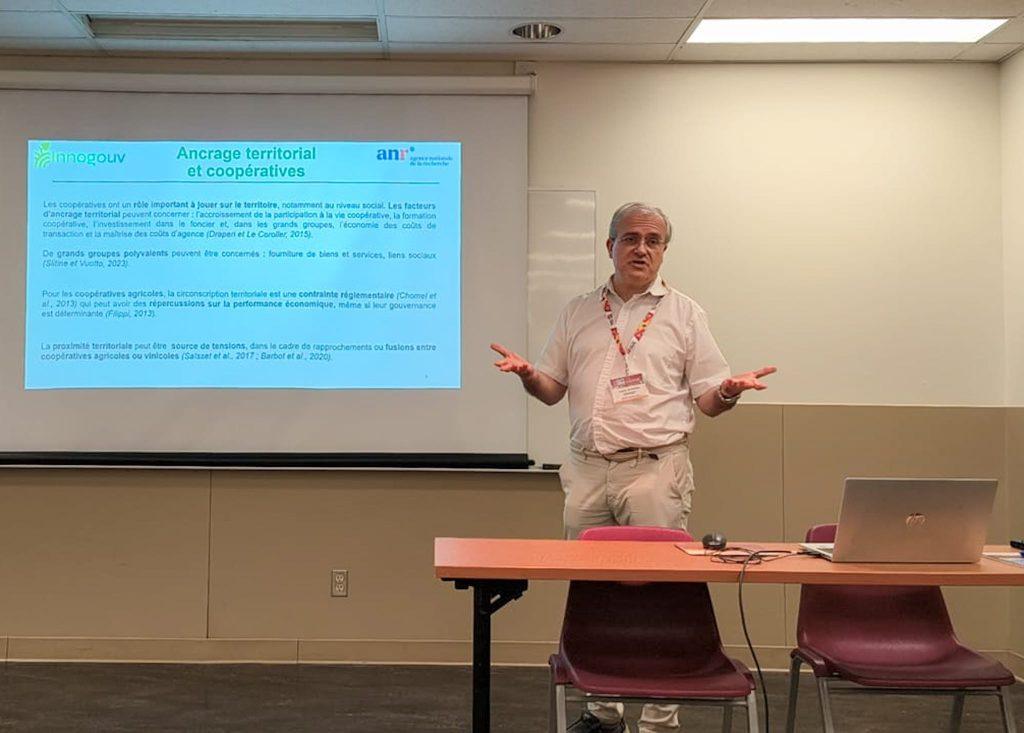
The work presented by Mohamed Makraz and Louis-Antoine Saïsset, co-authored with Yalé Koudou, Leïla Temri and Philippe MacClenahan, was titled "Territorial anchoring of wine cooperatives in France and their sustainable performance". It lies at the heart of the challenges of the INNOGOUV project, which studies the links between governance, innovation and sustainability in the wine cooperative sector.
Agricultural cooperatives are inherently linked to their territory by their legal status. Cooperative wineries, which represent 40% of French wine production and bring together 60% of winegrowers, particularly illustrate this anchoring. However, climate change, market instability and the variability of innovation capacities threaten the sustainability of this territorial link and call for renewed adaptation strategies.
The presentation was based on a quantitative survey conducted among more than 200 cooperative wineries spread across all French production basins. The first results reveal several notable trends. In terms of governance, a low representation of women (17.2% among members, 11.3% on boards of directors) and young people under 40 (16% among members, 19.5% on boards of directors) is observed, while more than a quarter of the wineries do not have a managing director.
Regarding varietal innovation, nearly half of the surveyed wineries (47%) have adopted new vine varieties, mainly in response to the effects of climate change, although the planted areas still remain limited. The main obstacles identified are the appellation specifications, consumer acceptance, as well as the availability and cost of plants.
In terms of sustainability, half of the wineries have developed a Corporate Social Responsibility (CSR) strategy, and nearly a quarter produce a dedicated CSR report. Environmental certifications are widely widespread, with a clear predominance of the Haute Valeur Environnementale (HVE) label, present in 87.5% of the surveyed wineries, followed by the Organic label (81%), while the Terra Vitis label remains less common (18%).
These first results pave the way for an in-depth analysis of governance forms and innovation strategies, as well as the development of relevant indicators to measure the sustainability performance of wine cooperatives in all its dimensions. (https://hal.science/hal-05252283v1)