Project
Cooperative wineries are facing the effects of climate change, which are reshaping the landscape from upstream to downstream, challenging both cultivation practices and production methods: shifts in vine phenology that increase exposure to frost risks, water scarcity, and droughts leading to hydric stress, lower yields, and maturity issues.
Furthermore, environmental regulations have become stricter, and consumers are increasingly mindful of the sustainability of how their food is produced. The focus is now on reducing pesticide use, recycling waste and packaging, and adopting agroecological practices.
The collective and democratic governance model of wine cooperatives, along with their deep local roots and social dimension, makes them key players in sustainable development. They innovate to adapt to market trends, climate disruption, and societal shifts, all while ensuring the best possible returns for their members (both shareholders and suppliers), which remains their primary objective.
Objectives
Scientific objective
The scientific objective is to understand the extent to which cooperative governance contributes to the development of technological innovations (such as the use of digital technology in vineyards and new grape varieties) and organizational innovations, and whether these, in turn, can influence the sustainability performance of wine cooperatives.
Operational objective
The operational objective is to help cooperatives and their members meet the challenge of sustainability through various forms of innovation. Through a scientific analysis of decision-making and management mechanisms regarding innovation and sustainability performance, we will highlight best practices and success factors.
This benchmark aims to enable cooperative leaders and cooperative winegrowers to improve their competitiveness and sustainability. For wine cooperatives, participating in Innogouv is a genuine opportunity to share experiences and reflect on how to enhance their economic, social, and environmental performance. Innogouv will also allow cooperatives and their unions to analyze their management and governance levers in order to address the climate, economic, and consumer behavior shifts they are currently facing.
Organisation
Partnership
In partnership with LCA Vignerons Coopérateurs, the Institut Coopératif du Vin (ICV), INRAE Transfert, the Haut Conseil de la Coopération Agricole (HCCA), and the Association Nationale de la Révision (ANR), the Innogouv research project brings together over 15 researchers from 6 different laboratories, spanning both the humanities and social sciences (economics, management, sociology) and the hard sciences (agronomy, genetics, environmental science). The project is structured around 3 work packages (WPs).
Funders
Project leaders

Louis-Antoine SAÏSSET Associate Professor


Leïla TEMRI Associate Professor

Geoffroy ENJOLRAS Full Professor

Work Packages
1) WP1, led by Louis-Antoine SAÏSSET (Institut Agro Montpellier), concerns the state of the art: it aims to explore governance, innovation and sustainability performance from a theoretical and bibliographical perspective.
2) WP2, led by Leila TEMRI (Institut Agro Montpellier), focuses on analysing the interactions between governance and innovation within wine cooperatives. It is based on a qualitative study involving interviews with 20 to 30 cooperatives in 2023-2024.
3) WP3, led by Geoffroy ENJOLRAS (Grenoble-Alpes University), studies the complex links between governance, innovation and sustainability performance. It is based on interviews and case studies, including an organisational life cycle analysis of a cooperative, as well as a large survey of 150 to 200 cooperatives scheduled for 2024.
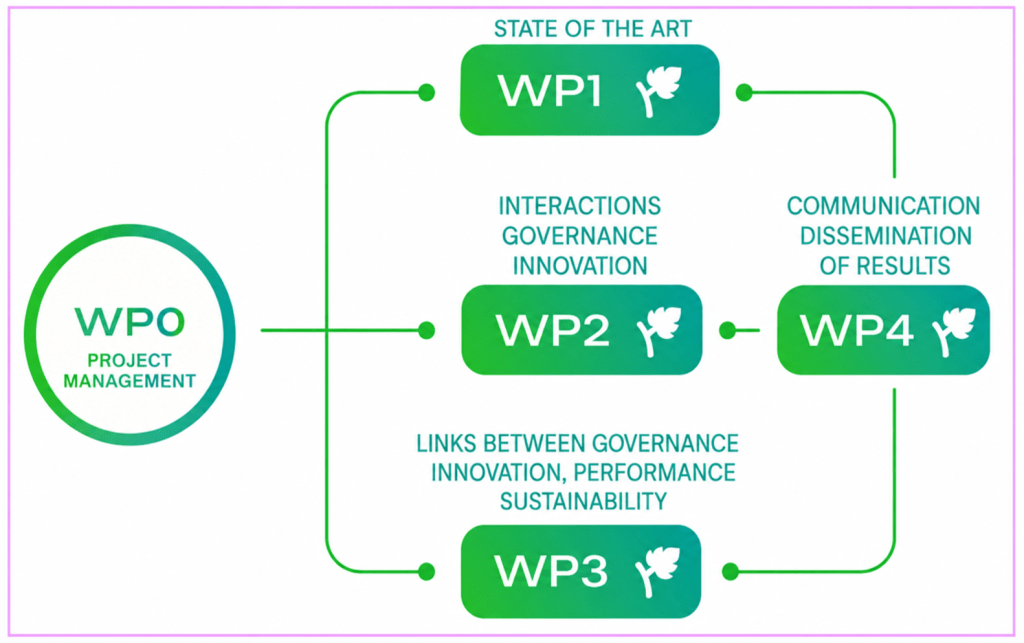
WP 1 - State of the Art
WP 2 Governance - Innovation Interactions
WP 3 - Linking Governance - Innovation - Sustainability Performance
Urbal Method
DOM BRIAL cooperative winery
Territorial cooperation, a sustainability performance lever for cooperative wineries ?
A case study by CIRAD
Application of the URBAL method to the DOM BRIAL territorial cooperation project (Pyrénées Orientales)
Elisabeth Mouchot
Faced with the deconsumption of wine and climate change, Vignobles Dom Brial, the first cooperative winery in Pyrénées-Orientales, wants to promote a territorial cooperation project. Structured around the recent establishment of a Cooperative Society of Collective Interest (SCIC) for land portage, Les Terres d’Hélios, the project aims to:
- Secure the land tenure,
- Support the establishment of young winemakers
- Increase the profitability of the wine sector,
- Increase the building of societal value for the territory
- Preserve resources
A qualitative and participatory evaluation of this project was conducted as part of the national research project INNOGOUV. The URBAL method, used for this ex-ante evaluation and applied for the first time to a cooperative winery, enabled the involvement of a broad range of stakeholders. The evaluation made it possible to map out impact pathways, revealing a process of “sustainability-making.” Through multiple interactions, collective learning could emerge around the search for shared solutions, potentially redundant ones. As the winery plays a brokering role between the collective of winegrowers and external stakeholders, it could help establish common rules to sustain the benefits of territorial cooperation. The evaluation thus highlights the concept of robustness, defined as a system’s ability to remain stable, and suggests expanding the measurement of sustainability performance by introducing robustness indicators. It also raises questions about the characterization of collective sustainability performance, territorial governance, and the role of public authorities in supporting these dynamics.
Full study report and Synthesis (both in French)